India heatwave days in 2025: 182, down from a record 554
India's heatwave days fell to 182 in 2025 from a record 554 in 2024, but the long trend still points up. State maps, how IMD counts, the 2026 heatstroke toll and the outlook.

November 3, 2026
In 30 seconds
182 heatwave days in 2025, added up across IMD's weather regions, about a third of the record 554 in 2024 (MoES, Aug 2025). Rajasthan was hit hardest.
20 confirmed heatstroke deaths and 4,853 suspected cases from March to late July 2026, by the health ministry's count (Lok Sabha, Aug 2026). Other agencies count differently.
About 25 heatwave days a season by mid-century under high emissions, up from about 5, according to India's own climate assessment (MoES, 2020).
Source: IMD, via Lok Sabha answers of 20 Aug and 3 Dec 2025. Each state shows its worst-hit IMD weather region. Hover or tap a state for its value.
India logged 182 heatwave days in 2025, according to IMD figures the Ministry of Earth Sciences gave Parliament. That is about a third of the record 554 in 2024, and the lowest count since 2021.
It sounds like good news, and for one year it was. But the drop followed an unusually cool, wet May, the long-term count is still rising, and health centres reported thousands of heatstroke cases in 2026.
India's heatwave days fell to 182 in 2025, but the trend still points up
182 heatwave days in 2025 compares with 554 in 2024, 230 in 2023 and 467 in 2022 (MoES answers of August and December 2025).
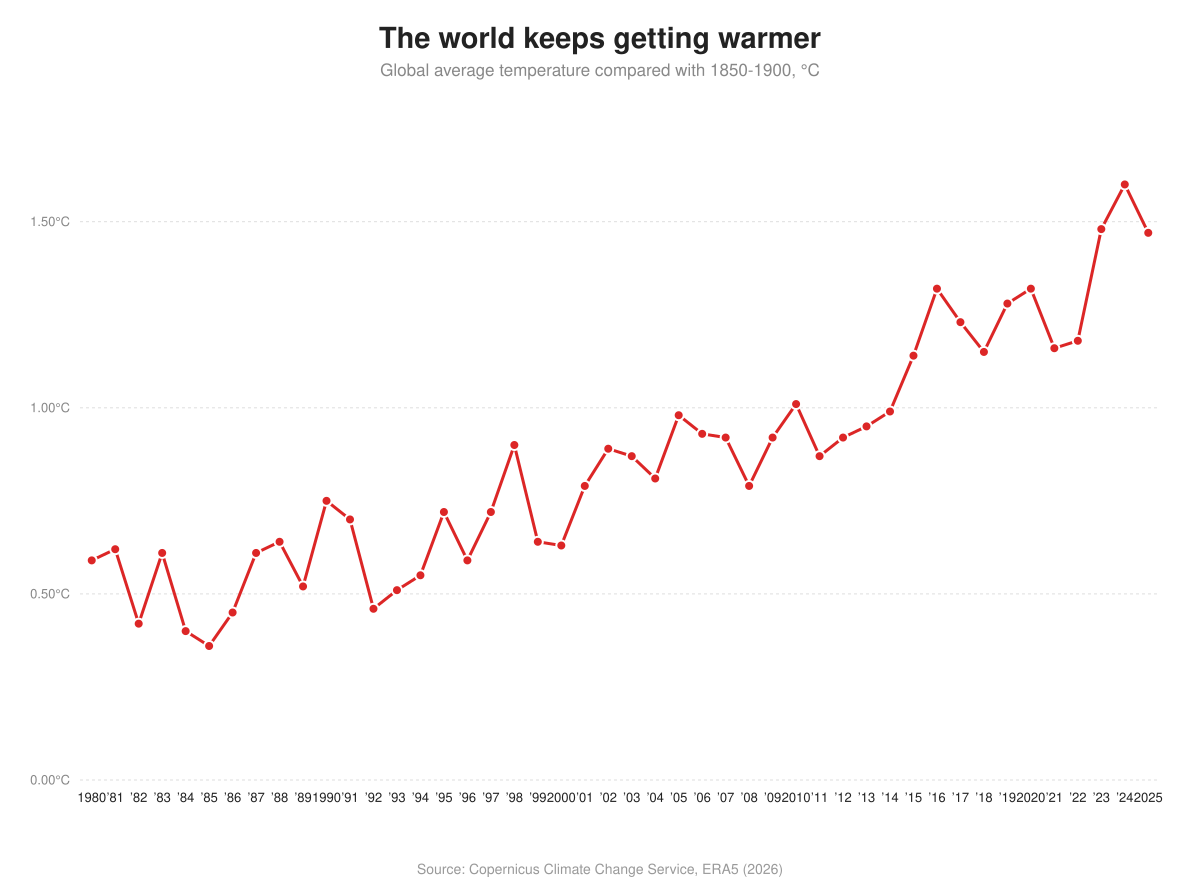
IMD's statement on the climate of India in 2025 says May was 0.81°C cooler than normal, with 126.7 mm of rain, the highest May rainfall on record. The year as a whole was still India's eighth-warmest since 1901, 0.28°C above the 1991-2020 average, and February was the hottest on record. 2024 holds the annual record, at 0.65°C above (for the world, see our global climate post).
From 2015 to 2025 the count swung widely, from 28 in 2020 to 554 in 2024 (MoES). The two highest totals came in the last four years. Over 1961 to 2020, IMD found "an increasing trend in the frequency of heatwaves in the heat core zone covering northern plains and central India", the ministry told Parliament (MoES, Aug 2025).
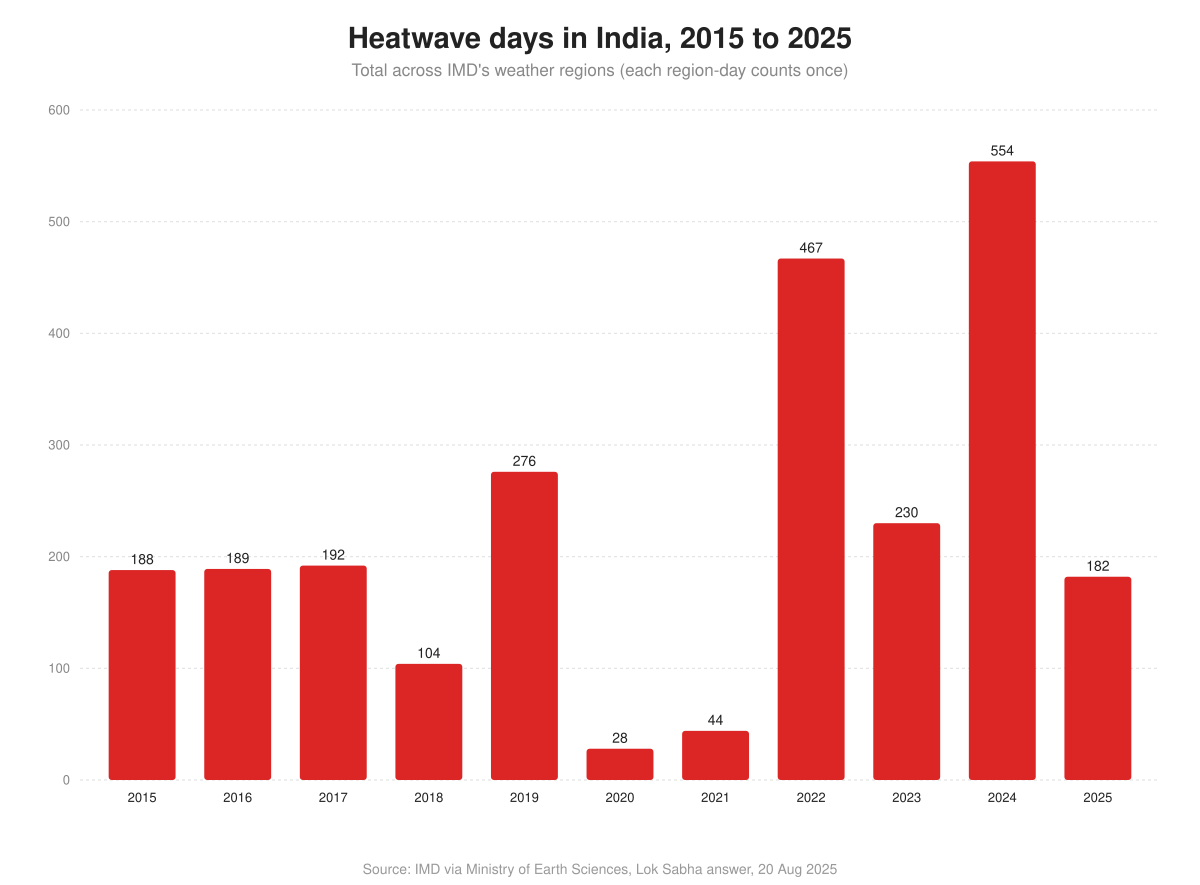
Source: IMD via Ministry of Earth Sciences, Lok Sabha answer of 20 Aug 2025.
IMD counts heatwave days by weather region, not by state
IMD splits India into 36 weather regions, called meteorological sub-divisions (IMD). A region has a heatwave when at least two of its stations pass IMD's test on two days in a row, and IMD declares it on the second day (IMD).
A station's top temperature must first reach 40°C on the plains, 30°C in the hills or 37°C on the coast. It is then a heatwave at 4.5 to 6.4°C above normal, or at 45°C and hotter. More than 6.4°C above normal, or 47°C and hotter, is a severe heatwave (IMD).
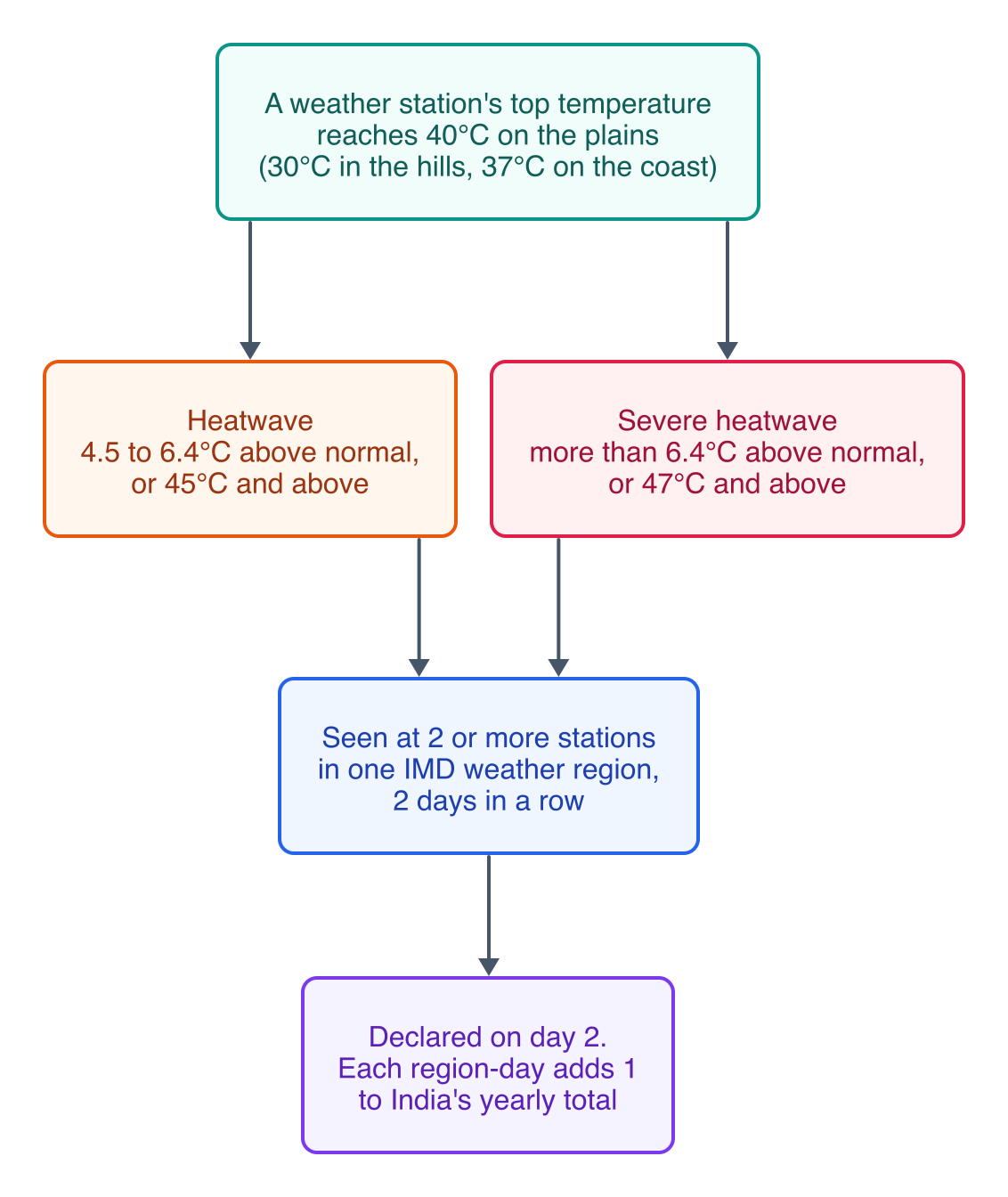
Source: IMD, "What is heat wave?" FAQ.
So the national total adds up region-days: 554 in 2024 means 554 region-days, not 554 calendar days. On the maps, a state that spans several regions shows its worst-hit one, and states that share a region share its number. Haryana, Chandigarh and Delhi are one region; Jammu and Kashmir and Ladakh are another. Four areas with no clean match in IMD's table, including Arunachal Pradesh, are blank.
Rajasthan had the most heatwave days in 2025; Odisha led in 2024
33 heatwave days in West Rajasthan put Rajasthan at the top of the 2025 map, and Sri Ganganagar there hit 49.4°C on 13 June (IMD). Gujarat had 15, Jammu and Kashmir and Ladakh 13, and Haryana, Chandigarh and Delhi 11 (MoES).
In 2024 the heat sat on the Gangetic plain and the east coast: Odisha 37, Uttar Pradesh 33, West Bengal 31, Bihar 30. The south flipped too. Andhra Pradesh, Karnataka, Kerala and Tamil Nadu had between 6 and 18 heatwave days each in 2024, and none in 2025 (MoES).
Source: IMD, via a Lok Sabha answer of 20 Aug 2025. Same 0 to 40 scale as the 2025 map.
2026 was not a record summer, but it had 4,853 suspected heatstroke cases
4,853 suspected heatstroke cases and 20 confirmed deaths were reported from 1 March to 26 July 2026 by the health ministry's heat-illness surveillance (Lok Sabha, 4 Aug 2026). Maharashtra had 11 of the deaths. Telangana (915), West Bengal (733) and Chhattisgarh (660) reported the most cases. Case counts depend on reporting as well as on heat.
There is no official state count of 2026 heatwave days yet. IMD's monthly summaries suggest Vidarbha, in eastern Maharashtra, was the hotspot (May summary), with East Uttar Pradesh next; East UP had 14 heatwave days in June alone (June summary). The ministry told Parliament that "unusually severe heatwave conditions were not witnessed" in 2026, compared with past extremes (MoES, Jul 2026).
Some records fell anyway. March 2026 had India's warmest March nights since 1901, with an average low of 19.00°C (IMD March summary), and Barmer reached 48.3°C on 12 May (IMD, 13 May 2026). Policy moved too: on the 16th Finance Commission's advice, heatwaves now qualify for state and national disaster relief funds for 2026 to 2031 (same answer).
Why heat death counts in India never agree
About 29 heat deaths appear in IMD's monthly summaries for March to June 2026, which draw on media and state reports (April, May, June). The health ministry confirmed 20 over a longer period. Both are government numbers for the same summer.
2025 had the same split. IMD's annual statement says heatwaves "claimed approximately 35 lives" (IMD). The National Centre for Disease Control confirmed 14 deaths up to 24 June, according to PTI, citing an RTI reply (The Week). HeatWatch, which scans news reports, counted at least 84, according to PTI (DT Next).
Police records give the biggest numbers. From 2015 to 2022, the National Crime Records Bureau counted 8,171 heat deaths, against 3,812 from the National Centre for Disease Control and 3,436 from IMD, according to PTI (The Week). For 2024, the bureau's figure was 1,832, according to The South First. A 2026 study estimated that one five-day heatwave could cause nearly 30,000 excess deaths across India's districts (Narang and Gadgil, 2026). They measure different things, so always say whose count you are quoting.
What comes next
No IMD heat outlook for summer 2027 yet. IMD usually issues it at the end of February; the 2026 one came on 28 February (IMD). As context, not an India heat forecast: IRI at Columbia University gives the current El Niño, already very strong, a 100% chance of lasting through March to May 2027 (IRI, 19 Oct 2026).
About 25 heatwave days a season by mid-century, and 35 by 2100, under high emissions, against about 5 in 1976-2005; on a middle path, about 15 and 18. These are April to June model projections, not IMD region-day counts (Sanjay and others, 2020).
About 30 times as many severe heatwaves by 2100 as today, even if global warming stays at 2°C (Mishra and others, 2017).
16 to 20 crore people (160 to 200 million) in India could face lethal heatwaves each year as early as 2030 without access to sustainable cooling (World Bank, 2022, citing McKinsey).
2.8 times a decade is how often a once-a-decade hot extreme over land worldwide now happens, and 5.6 times at 2°C of warming (IPCC, 2021). The IPCC expects South Asia's heatwaves to grow more intense and frequent (Asia fact sheet).
How this map stays current
Both maps in this post are live iipmaps embeds, not screenshots. When IMD publishes official 2026 counts, we can update each map once and every page that embeds it will show the new numbers; a newsroom can also link a map to a Google Sheet so it updates itself. Read why live maps beat screenshots, or try the tutorial on turning an IMD PDF into a live map.
Frequently asked questions
What is a heatwave day in India?
IMD declares a heatwave when at least two stations in one of its weather regions pass its temperature test on two days in a row (IMD). India's yearly total adds up region-days, not calendar days.
Which state had the most heatwave days in 2025?
Rajasthan, with 33 in West Rajasthan, ahead of Gujarat with 15 (MoES). That is West Rajasthan's count, because each state shows its worst-hit IMD region.
How many people died of heat in India in 2026?
It depends on who counts. The health ministry confirmed 20 heatstroke deaths from 1 March to 26 July (Lok Sabha), and IMD's monthly summaries list about 29 for March to June. Police figures for 2026 are not out yet.
Sources
Ministry of Earth Sciences, Lok Sabha unstarred question 4374 (20 Aug 2025)
IMD, monsoon information page (meteorological sub-divisions)
IMD, Statement on the Climate of India during 2025 (1 Jan 2026)
Ministry of Earth Sciences, Lok Sabha unstarred question 678 (22 Jul 2026)
PTI via DT Next, HeatWatch count of 2025 heatstroke deaths (22 Aug 2025)
IMD, outlook for March to May 2026 (28 Feb 2026), copy hosted by NCDC
Mishra, Mukherjee, Kumar and Stone, Environmental Research Letters 12:124012 (2017)
World Bank, Climate Investment Opportunities in India's Cooling Sector (Nov 2022)